
Diagnose
Map where work waits, returns for correction and repeatedly needs information or senior intervention.
Process redesign consulting and outsourced production for communications firms.
Mekong Bridge Advisory redesigns communications workflows so output is more consistent, account knowledge stops leaving with people, and senior time stops going into rework and oversight. Where more capacity is needed once the standard exists, MBA can run the agreed recurring production too.
Process redesign is the core of the work and delivers value on its own. Production follows once the standard exists and you want MBA to help run it. Two supporting capabilities sit alongside both.
Diagnose where capacity is being lost, identify the causes and redesign the workflow so the right knowledge and checks enter before production begins.
See how it worksRecurring production operated by MBA against the agreed process, sources, templates, quality checks and escalation points.
See how it worksAI-search visibility, and business-development and pitch support. Specialist workflows available alongside the core offer, not a substitute for it.
See how it worksMBA finds where capacity is being lost, removes the causes, and redesigns the workflow so knowledge, sources and checks are applied before problems reach a senior person. Only then does the question of who operates it arise.
Map how the work currently moves: where it waits, what returns for correction, and where senior people repeatedly intervene on steps that do not require judgment.
Build known client requirements, approved sources, review points and quality checks into the process, so issues are prevented rather than corrected at review.
Operate the redesigned process internally, ask MBA to run the agreed recurring production, or divide delivery between both teams.

Your team runs the process, with no ongoing MBA fee. Best when capacity is fine but the process, standard or quality controls are not.
MBA runs the agreed production against your standard. Your team keeps the client relationship and final approval. Best when capacity is tight and the production can be clearly defined.
Your team keeps the judgment-heavy work. MBA runs the agreed repeatable production. Best when a process mixes routine output with sensitive decisions.
Whichever model you choose, the redesigned workflow, standards and materials remain with your team.

Recurring problems rarely begin with drafting. They start earlier – account knowledge scattered across people and conversations, unclear sources, repeated handovers, quality checks applied after the work is produced. Adding capacity to a process built this way multiplies the problem.
Map where work waits, returns for correction and repeatedly needs information or senior intervention.
Separate the visible problem from its causes: missing knowledge, inconsistent sources, unclear review points or repeatable work mixed with judgment.
Change the sequence so established knowledge, approved sources and required checks enter before avoidable issues reach senior review.
The result is not process for its own sake. It is more senior time for clients and new business, and more room to take on additional work without adding headcount first.
The trial establishes what is happening now, why the problems recur and what should change. It is delivered as a focused DMAIC sprint. MBA redesigns and tests the selected workflows before recommending broader implementation or production.
Agree on the process, problem, scope and success measures.
Review previous work, task time, revision rounds, waiting and senior involvement.
Map the workflow and identify the causes of defects, non-utilised talent and work waiting.
Redesign the process so known information, approved sources and quality checks enter earlier.
Test the redesigned workflow and establish the standards, QA and maintenance needed to sustain it.
The client retains the redesigned workflow and materials developed during the trial, whether or not it continues into Build or Run.
The redesigned workflow gives supporting teams clearer direction before production begins, while keeping professional judgment and exceptions with the right people. Depending on the process, this typically falls into four areas:
A clear sequence showing who does what, where the work waits for review, and when it should go to a senior person instead of moving forward automatically.
Established client preferences, past decisions and approved wording, plus defined sources and checks for keeping information current.
Documented instructions for stable, repeatable work, along with templates and structured prompts — including AI Consultants, where a consultable system helps make existing client and process knowledge available before a task begins.
Review criteria applied consistently before work moves forward, and a controlled process for reviewing what’s been learned and updating the system as requirements change.
The exact build depends on the process. MBA structures what is known, preserves human responsibility for what is new and removes avoidable dependency from the workflow.
MBA provides recurring production capacity for selected communications workflows. The work is operated against agreed processes, sources, templates, quality checks and escalation points — not treated as a generic task handover.
Collect, filter, classify and organise relevant coverage for final human quality review.
RecurringPrepare structured reporting outputs using agreed data sources, templates and review requirements.
RecurringGather, organise and synthesise approved information for account teams and client work.
On requestRecurring newsletter, LinkedIn and content workflows, run within established voice, source and approval requirements.
RecurringResearch, structure and production for agreed business-development materials, with senior teams retaining strategic direction.
SelectedVolumes, timelines, review responsibilities, overage triggers and out-of-scope work are agreed before Run begins.
These capabilities sit alongside MBA’s core process-redesign and production offer. They remain visible without competing with the main proposition.
MBA tests agreed buyer and stakeholder questions across selected AI-search platforms, then develops content using approved sources and your existing approval process.
Qualification: Visibility develops over time and depends on factors outside MBA’s control. It is measured against an agreed question set, never presented as a guaranteed ranking or citation outcome. The agency retains the client relationship while MBA supports the diagnostic, content and monitoring workflow.
Book a discussion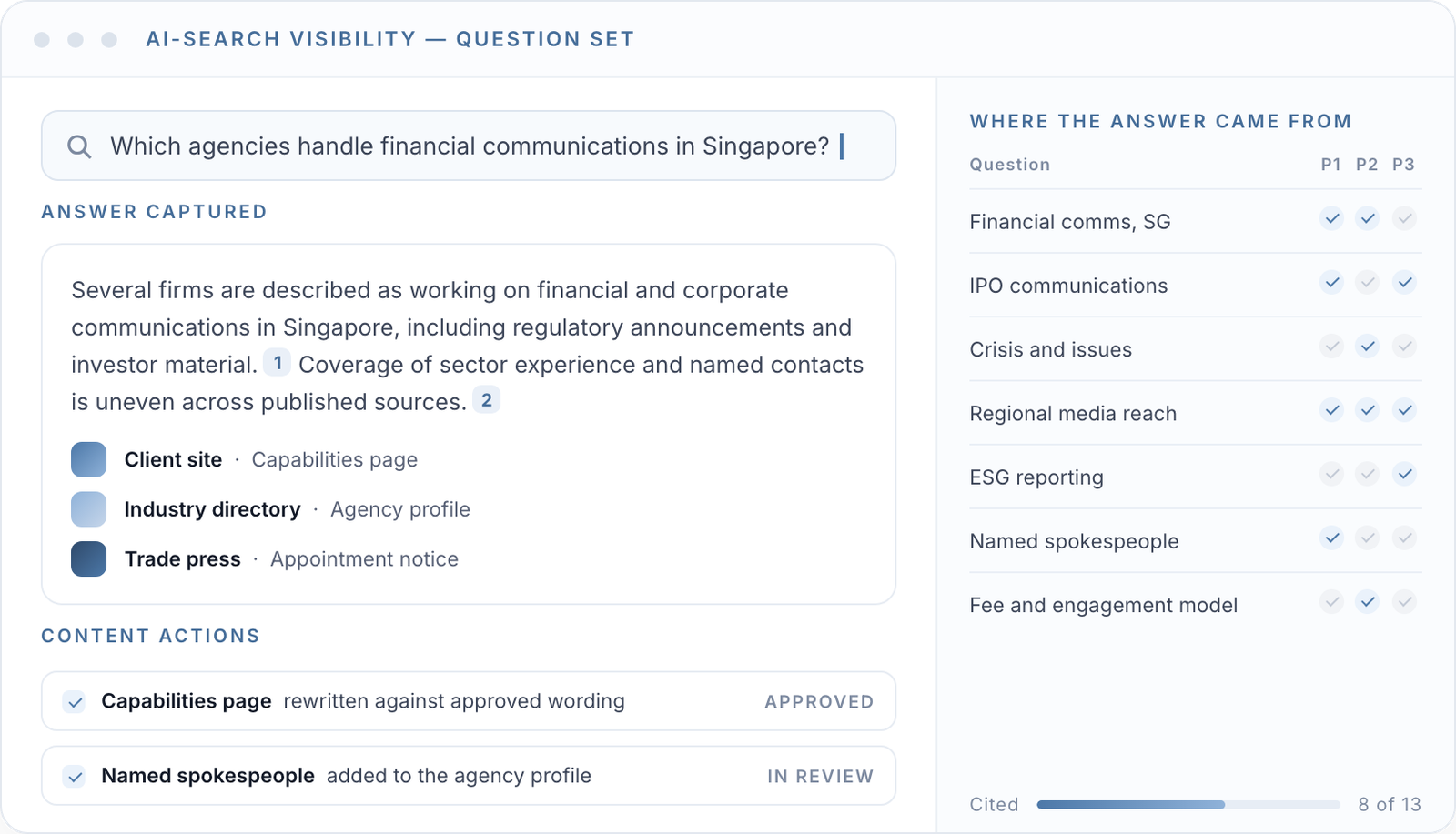
MBA supports the research, narrative structure and presentation production behind selected pitches – reviewing the brief and the opportunity, gathering evidence, and preparing material for senior review – so agency leaders can concentrate on strategic choices and the client conversation.
Qualification: The agency remains the face of the pitch and owns the final recommendation. MBA strengthens the development process and does not guarantee a win.
Book a discussion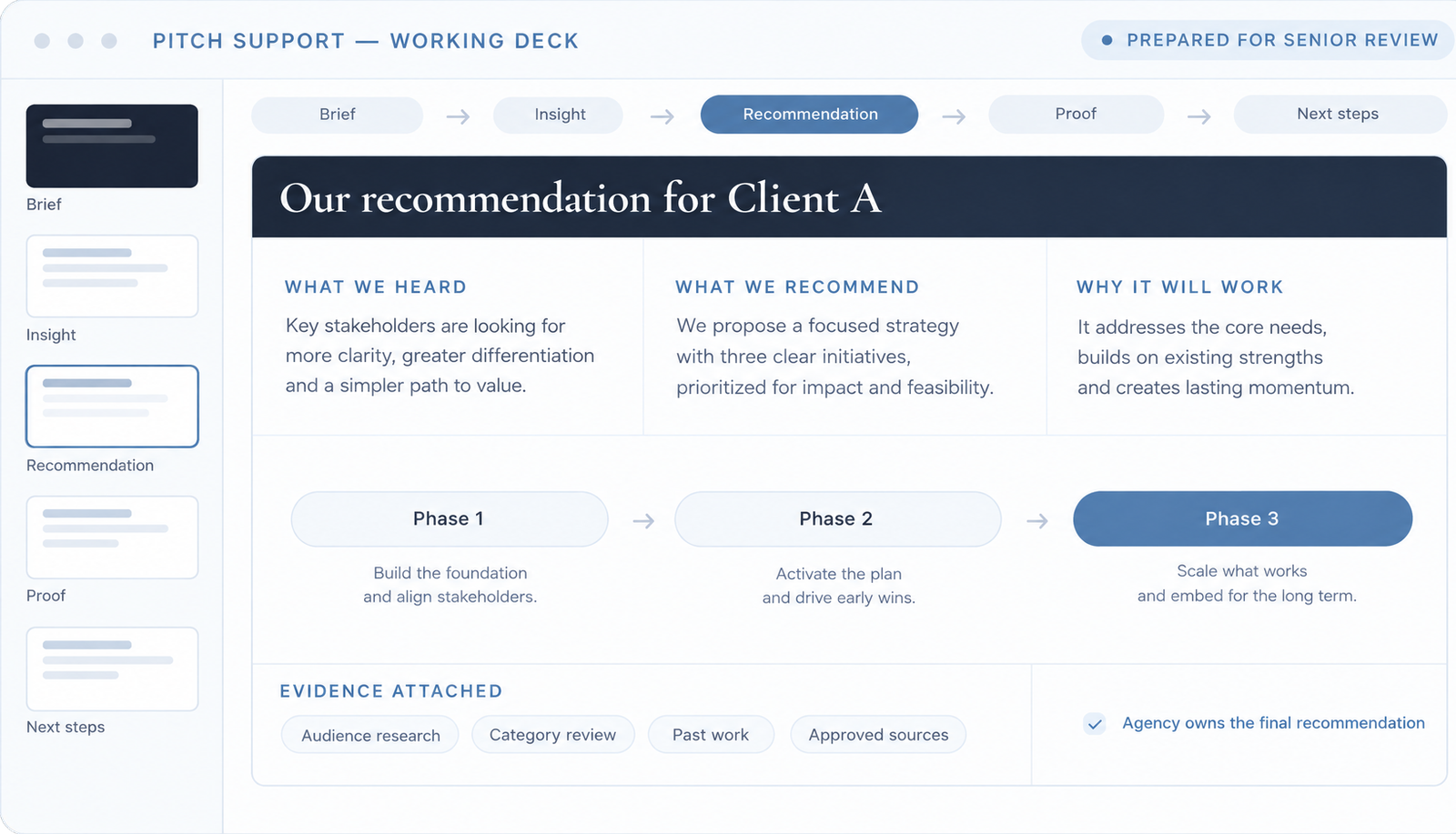
Start with the workflows consuming the most senior time, creating the most rework or waiting most often for direction.
Book a discussionWhich two processes should we examine first?